
Why Chasing Ultra-Low Inflation Could Stifle Economic Progress Where It’s Needed Most
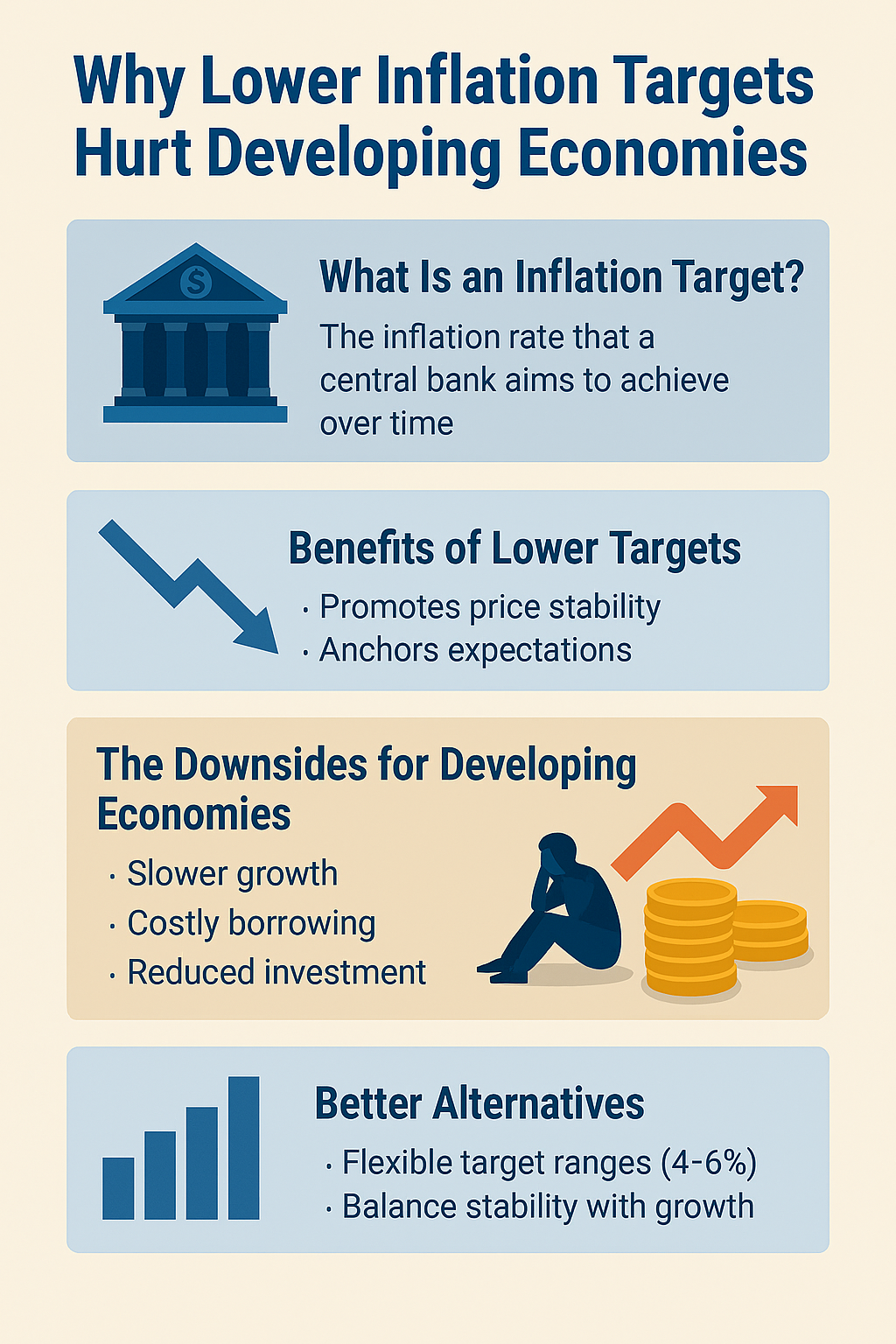
When central banks announce a lower inflation target, it often makes headlines as a bold move toward economic discipline. After all, inflation is widely seen as the enemy of stability—eroding purchasing power, distorting markets, and undermining confidence. But while a lower target may sound like a triumph for price stability, it comes with trade-offs that can be particularly harmful for developing economies.
In fact, this policy shift can slow growth, discourage investment, and even exacerbate inequality. Let’s unpack why lowering inflation targets is not the panacea it appears to be—and why developing nations should think twice before following this trend.
The Appeal of Lower Inflation Targets
Inflation targeting became a cornerstone of modern monetary policy in the late 20th century. By committing to a clear, measurable goal—say, 2% annual inflation—central banks aim to anchor expectations, reduce uncertainty, and foster trust in the currency.
Lowering the target even further, perhaps from 4% to 2% or from 3% to 1%, signals a strong commitment to price stability. For advanced economies with mature financial systems and low structural inflation, this can reinforce credibility and keep borrowing costs predictable.
But here’s the catch: what works for developed economies doesn’t always translate well to developing ones.
Why Lower Targets Hurt Growth
To hit a lower inflation target, central banks typically tighten monetary policy—raising interest rates, restricting credit, and sometimes even curbing fiscal expansion. While these measures can tame inflation, they also dampen aggregate demand.
For developing economies, where growth depends heavily on investment in infrastructure, manufacturing, and human capital, tighter monetary conditions can be crippling. Higher interest rates make borrowing costlier for businesses and governments alike. Public projects stall, private investment slows, and job creation suffers.
In short, the very tools used to achieve ultra-low inflation often choke the lifeblood of economic development: capital formation and consumption.
The Structural Reality of Developing Economies
Unlike advanced economies, developing nations face structural challenges that naturally push inflation higher—volatile commodity prices, supply chain inefficiencies, and less diversified production bases. Attempting to force inflation down to levels typical of advanced economies ignores these realities.
Moreover, moderate inflation (say, 4–6%) can actually be beneficial for developing economies. It allows relative prices to adjust, supports wage growth, and provides governments with fiscal flexibility. A rigidly low target, on the other hand, risks creating deflationary pressures that stifle progress.
The Investment Signal Problem
Lower inflation targets also send a mixed signal to investors. While price stability is attractive, excessively tight monetary policy can make returns less appealing, especially in emerging markets where risk premiums are already high.
Foreign investors may interpret ultra-low targets as a sign that growth will be subdued, reducing the incentive to commit long-term capital. Domestic entrepreneurs face similar hurdles—why expand production when credit is expensive and demand is weak?
The Employment Trade-Off
Perhaps the most overlooked consequence is employment. Developing economies often have large informal sectors and high underemployment. Growth is essential to absorb labor into productive activities. When monetary policy prioritizes ultra-low inflation over growth, job creation slows, and social tensions can rise.
This trade-off is stark: price stability at the expense of livelihoods.
Global Lessons and Policy Recommendations
History offers cautionary tales. Countries that aggressively pursued low inflation targets during periods of structural transformation often paid a heavy price in lost growth. Conversely, those that tolerated moderate inflation while investing in productivity—think of post-war Japan or modern-day Vietnam—achieved rapid development without spiraling into hyperinflation.
For developing economies, the lesson is clear: don’t blindly mimic advanced economies’ inflation targets. Instead, adopt a pragmatic approach that balances stability with growth. A flexible target range—say, 4–6%—may better reflect structural realities and development goals.
Conclusion: Stability Shouldn’t Mean Stagnation
Lowering inflation targets may look like a badge of honor for central banks, but for developing economies, it can be a growth trap. Price stability is important, yes—but not at the cost of progress.
Economic policy should serve people, not just numbers. And for nations striving to lift millions out of poverty, rigidly low inflation targets risk doing more harm than good.
The bottom line? Stability matters, but so does momentum. Developing economies need both.